
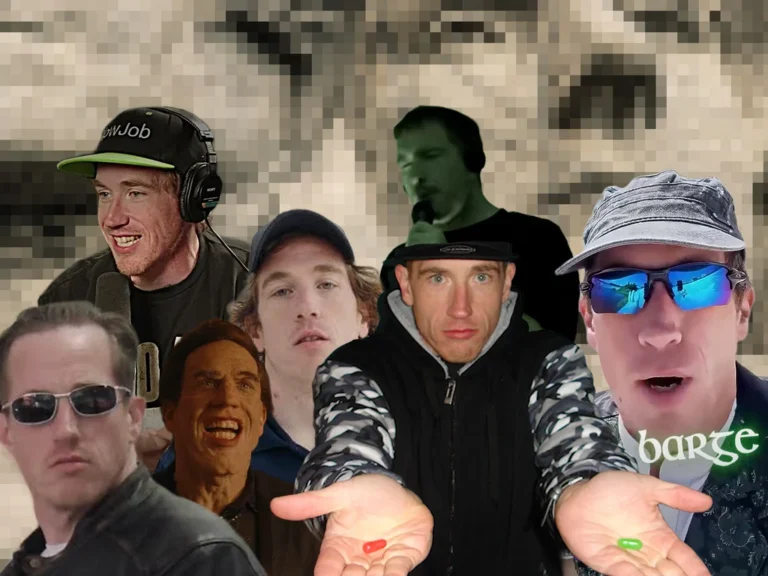
Conner O’Malley’s latest work turns the American Dream inside out, tracing how social media floodlights shape ambition, fear, and mock heroism. The piece situates his short‑form videos within a larger network of creators who monetize attention while critiquing the very system that feeds them.
His ongoing preoccupations center on a persona that oscillates between hapless everyman and performative hustler. A notable moment in the profile is the evolution where two competing versions of himself fuse into the “Ultimate Corey,” a grotesque, over‑engineered figure rendered with prosthetics. An AI‑assisted sequence marks that transformation, underscoring a moment when technology and fantasy blur into a singular appetite for spectacle.
Two landmarks in one arc: Coreys and Rap World
The feature discusses Coreys, a 12‑minute piece that begins as a brisk, abrasive riff on a self‑absorbed consumer mindset and spirals into a Lynchian panorama of split identities and nightmarish visuals. The discussion then moves to Rap World, a 55‑minute mock home movie from 2009 that follows friends in Tobyhanna, Pennsylvania, as they chase a rap project across a living room and a drive‑through caper.
Shot on vintage gear, Rap World anchors its story in the late‑2000s recession and the social devastation it left in its wake. The setting foregrounds white male mobility pressures, the erosion of domestic responsibility, and a cascade of misadventures that culminate in a memorable joke about mortality and meaning. The piece argues that this historical frame gives the film a prescient sting about who gets to call the shots in America—and who remains captive to want.
Viral mechanics and the politics of hustle
Throughout, O’Malley leans into the grammar of clip farming, vertical video, filtered nostalgia, and fake news textures—techniques that mirror the way audiences consume content in a flood of out‑of‑context snippets. The author notes GoFundMe scams, manosphere chatter, and dubious side hustles as recurring motifs, with GoFundMe and conspiracy theories appearing as visceral props on screen.
The persona in these works speaks to a broader melancholy: a society where the dream of ascent is increasingly mediated by algorithms, influencer culture, and the theater of risk. The piece suggests that O’Malley’s work captures a moment when the dream and the hustle are inextricably bound, often at the expense of real life and ordinary progress.
In wrapping, the author treats Rap World as a document of its era: a bittersweet artifact that traces the birth of a class of self-styled “suckers” navigating a diminished middle class and a political economy that feels rigged. It’s positioned as a landmark in 2024 American cinema for its unflinching portrait of aspiration run amok.
Source: Original article