
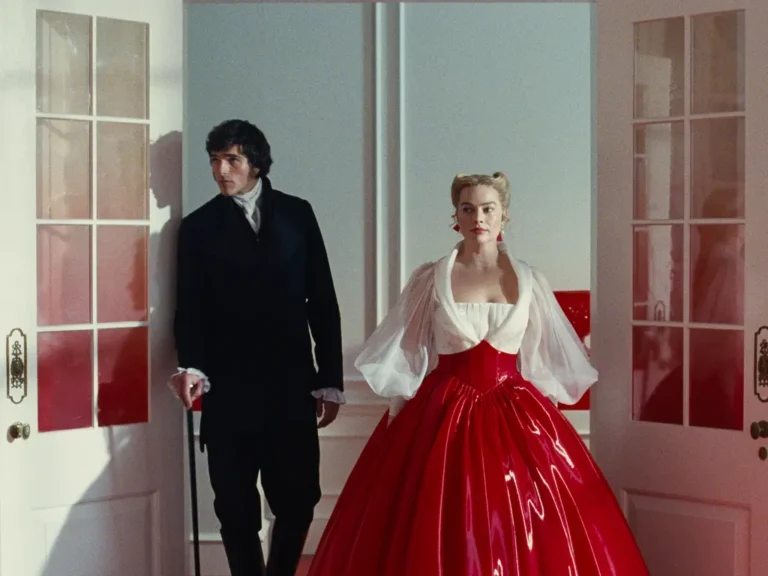
Emerald Fennell outfits Wuthering Heights with a bold, fashion-forward vision that trades the moody depths of Brontë’s novel for a glossy, maximalist spectacle. The result is undeniably striking, but the emotional pulse that drives the source material never fully lands.
Margot Robbie and Jacob Elordi take on Cathy and Heathcliff, carrying star power more than volatile danger. Their romance unfolds in rapid montages set to contemporary pop, prioritizing mood over the hard honesty that makes the book endure.
The design elements are where the film truly catches the eye: Jacqueline Durran’s costumes glow with opulence, and Suzie Davies’ production design drapes Thrushcross Grange in a style-forward world. Linus Sandgren’s cinematography bathes the scenes in a painterly light, giving the film a poster-loving sheen throughout.
Yet the film’s bravura visuals can’t disguise a softened core. Heathcliff’s brutality is tamed, and Nellie’s scheming as the narrative engine robs Cathy and Heathcliff’s passion of its fierce danger. The drama becomes a glossy tract rather than Brontë’s relentless inquiry into class, abuse and intergenerational trauma.
The sex and romance sequences, teased in interviews, lack the rough immediacy the relationship deserves. Robbie and Elordi often feel like famous collaborators more than tragic lovers, their connection rendered palatable rather than perilous. A standout moment arrives when Heathcliff kneels and gently touches Cathy’s finger in a confession; it’s the film’s rare instance of cold-blooded sensation amid a sea of stylized restraint.
The supporting cast lands unevenly. Shazad Latif’s Edward Linton reads as mild rather than menacing, and Alison Oliver’s character pivots too quickly from innocence to submission. Martin Clunes, as Cathy’s father, provides a rare, sincere spark, though even that beat is undercut by a tonal joke that leeches tragedy of gravity.
Ultimately, Fennell’s strengths—unapologetic visual ambition and a keen eye for collaboration—are clear. But the atmosphere she creates remains a surface mood, not a realm in which the heart can live. The film feels built for mood boards and social feeds while the real ache of the story stays out of reach.
In a closing note, the filmmaker leaned on a curated cinema program ahead of release, a cascade of iconic titles meant to illuminate her approach. Read in hindsight, that gesture reads less as a promise than a warning: artistry and brand spectacle don’t guarantee resonance. The movie shines, but it doesn’t endure.
Images Courtesy of Warner Brothers

Source: https://lwlies.com/reviews/wuthering-heights-2
Source: Original article