
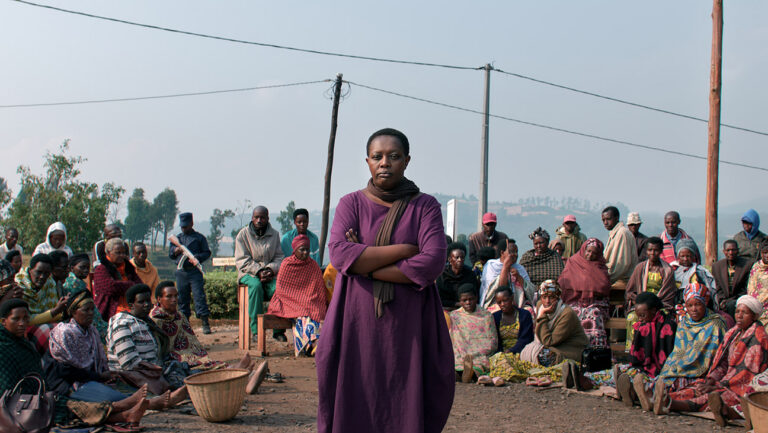
In a debut feature that places Rwanda squarely on the festival map, a woman’s fierce longing for truth grounds a broader national reckoning. Vénéranda’s opening moments carry a push and pull between forgiveness and memory, her folded arms signaling that healing is not simple.
Directed by Marie-Clémentine Dusabejambo, the film screened in Cannes’ Un Certain Regard and unfolds in 2012, as the Gacaca era nears its end in the village of Kibeho. The story follows Vénéranda alongside her teenage daughter Tina, her sister Suzanne, and their ailing mother, weaving in other village women to expand the portrait.
Memories are shared in intimate circles outside the formal courts, part of Rwanda’s broader healing project known as Rwanditude. Ethnic labels recede in these gatherings, but the personal betrayals and the instinct to forgive are put to the test through the women’s testimonies.
Nyirinkindi, Kabano, and Nishimwe lend the film its emotional core, with Tina and her partner Richard embodying a younger generation negotiating love, stigma, and the legacies of division. Vénéranda’s insistence on family care sits against her own stern judgments, revealing the friction between compassion and conscience.
The film’s craft is precise and quietly powerful: restrained cinematography by Mostafa El Kashef, thoughtful production design by Ricardo Sankara, and a lyrical score by Igor Mabano that heightens emotion without shouting. The result is cinema that trusts character and detail, turning a village’s quiet sounds and light-filled interiors into a room where memory becomes visible.
With a runtime of 1 hour 41 minutes, Ben Imana offers a feverish, human tableau of a society learning to face its past through truth, accountability, and solidarity among women.
About the title and the people behind the film
The title carries a Kinyarwanda sense of collective identity, signaling a shift away from ethnic labeling toward shared responsibility in the wake of brutality.
- Cast: Clémentine U. Nyirinkindi, Isabelle Kabano, Kesia Kelly Nishimwe
- Director: Marie-Clémentine Dusabejambo
- Screenwriters: Dusabejambo with Delphine Agut
- Production: Ejo Cine, Ogweli Productions, Les Films du Bilboquet, DUOfilm, Princesse M Productions
Source: Original article